
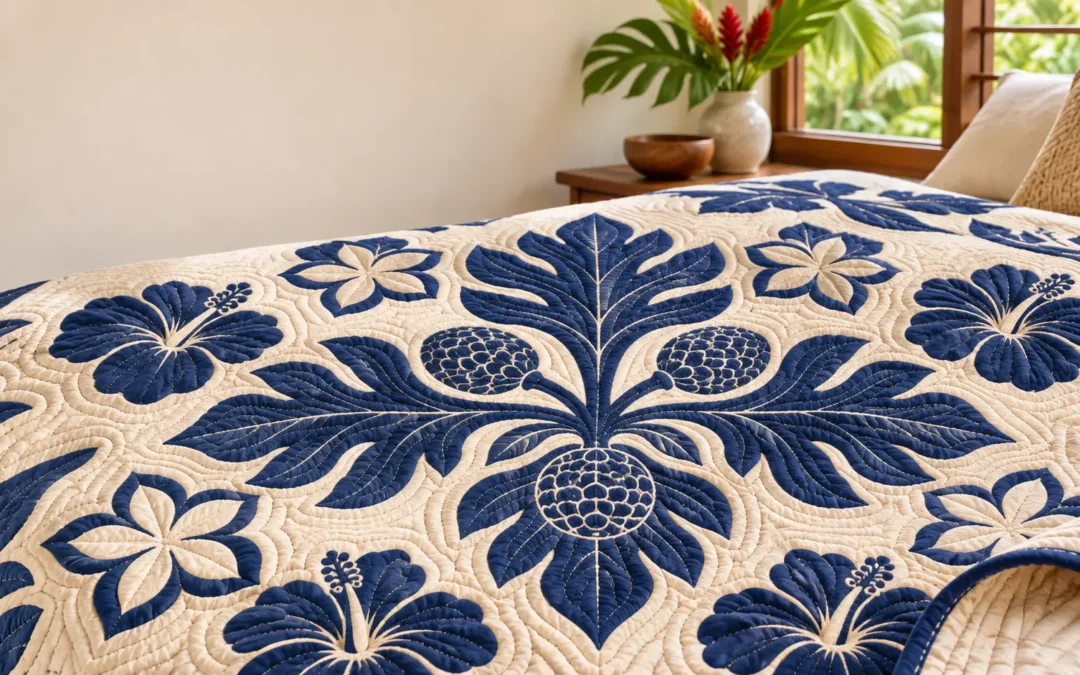
Understanding Hawaiian quilt patterns and their meanings offers a deeper appreciation of the craftsmanship behind these treasured textiles. From the abundance represented by the ʻulu (breadfruit) to the enduring qualities associated with the honu (sea turtle), each design can carry a unique connection to Hawaiian life.
Whether you are exploring traditional Hawaiian quilt designs, choosing a meaningful gift, or decorating your home with island-inspired textiles, this guide introduces popular patterns, their symbolism, and the techniques that make Hawaiian quilting distinctive.
What Are Hawaiian Quilt Patterns?
Hawaiian quilt patterns are decorative designs traditionally inspired by the plants, flowers, and natural surroundings of Hawaiʻi. Many feature large, symmetrical motifs created through appliqué, a sewing technique in which fabric shapes are attached to a contrasting background.
Unlike conventional patchwork quilts, which often combine numerous fabric pieces into geometric arrangements, traditional Hawaiian quilts typically showcase one prominent design extending outward from the center.
These designs frequently represent elements of Hawaiian identity, including family, growth, hospitality, and appreciation for nature.
The beauty of Hawaiian quilting lies in its combination of artistic expression and cultural significance. Each pattern reflects the quilter’s creativity, while the stitching demonstrates patience, precision, and dedication.
The Cultural History of Hawaiian Quilting
Hawaiian quilting developed during the 19th century after Western missionaries introduced quilting techniques to the Hawaiian Islands.
Hawaiian women adapted these methods into a distinctive art form influenced by their existing textile traditions and natural environment.
Before the introduction of Western quilting, Native Hawaiians produced kapa, a traditional cloth made from beaten plant fibers. Kapa making already involved sophisticated craftsmanship and decorative patterns.
As quilting developed, Hawaiian artisans created increasingly elaborate appliqué designs featuring familiar plants, leaves, and flowers.
Over generations, quilts became meaningful family possessions, often presented as wedding gifts, passed down as heirlooms, or created to commemorate important occasions.
Today, Hawaiian quilts continue to celebrate the islands’ artistic heritage through traditional techniques and contemporary interpretations.
Popular Hawaiian Quilt Patterns & Meanings
Many traditional Hawaiian quilt designs draw inspiration from the natural environment. While certain plants and animals have widely recognized cultural associations, the meaning of an individual quilt may also depend on its creator, family history, or intended recipient.
The following patterns illustrate how Hawaiian quilting connects nature, symbolism, and artistic expression.
ʻUlu (Breadfruit): Abundance and Prosperity
The ʻulu, or breadfruit, pattern is one of the most recognizable designs in Hawaiian quilting.
Breadfruit has long been an important food source in Hawaiʻi. Its association with nourishment and abundance makes it a meaningful subject for traditional artwork.
The ʻulu design is commonly associated with:
- Abundance and prosperity
- Nourishment and generosity
- Family well-being
- Growth and new beginnings
In some Hawaiian quilting traditions, ʻulu is considered an auspicious first pattern for a quilter because of its association with abundance.
Its distinctive leaves create striking symmetrical designs, making it especially suitable for bedspreads and decorative wall hangings.
For homeowners seeking a Hawaiian quilt that reflects growth and prosperity, ʻulu-inspired designs offer a meaningful choice.
Kalo (Taro): Family and Ancestral Connections
Kalo, commonly known as taro, holds a particularly important place in Native Hawaiian culture.
Beyond its value as a traditional food source, kalo is connected to Hawaiian genealogy and stories of ancestry.
In Hawaiian tradition, Hāloa, the first kalo plant, is closely linked to the ancestry of the Hawaiian people.
Because of this cultural connection, kalo-inspired quilt patterns can evoke:
- Family relationships and ancestry
- Cultural identity and belonging
- Sustenance and responsibility
- Respect for previous generations
Kalo designs often incorporate large, heart-shaped leaves arranged in balanced, repeating patterns.
A quilt featuring kalo can serve as a reminder of the enduring relationship between family, land, and Hawaiian heritage.
Honu (Sea Turtle): Longevity and Protection
The honu, or Hawaiian sea turtle, is a beloved subject in island-inspired art.
Honu are often associated with longevity, resilience, peacefulness, and protection. Their graceful movements through the ocean make them popular subjects for quilts, paintings, jewelry, and home décor.
Common interpretations of honu designs include:
- Longevity and endurance
- Protection and guidance
- Peace and tranquility
- Connection to the ocean
In Hawaiian quilting, honu patterns frequently feature symmetrical turtle silhouettes surrounded by flowing shapes inspired by ocean waves.
These designs are particularly appealing for coastal interiors, children’s rooms, and homes featuring tropical decorative elements.
The honu motif also serves as a reminder of the importance of respecting and protecting Hawaiʻi’s marine environment.
Pineapple: Hospitality and Warmth
The pineapple is widely associated with hospitality, welcome, and tropical living.
Although pineapple is not native to Hawaiʻi, it became closely connected with the islands through its agricultural history and cultural imagery.
Pineapple-inspired Hawaiian quilt patterns often symbolize:
- Hospitality and friendship
- Warmth and generosity
- Celebration and togetherness
- Tropical island beauty
The distinctive pineapple crown and textured fruit provide inspiration for elaborate appliqué arrangements.
Some designs combine pineapple leaves with geometric or floral elements, creating an evocative visual centerpiece.
Pineapple quilts are particularly suitable for guest bedrooms, vacation homes, and welcoming living spaces.
Their cheerful appearance makes them a popular option for homeowners seeking traditional Hawaiian-style décor with a recognizable tropical theme.
Mango: Sweetness and Abundance
Mango trees are a familiar feature of many Hawaiian landscapes, valued for their fruit and broad, leafy canopies.
In decorative interpretations, mango-inspired quilt designs may represent abundance, sweetness, generosity, and the pleasures of island living.
These designs can evoke:
- The rewards of growth and patience
- Abundance and generosity
- Appreciation for nature
- The warmth of family gatherings
Mango patterns may incorporate elongated leaves, fruit shapes, and flowing botanical arrangements.
Their organic forms allow quilters to create intricate silhouettes while maintaining the balanced composition associated with Hawaiian quilting.
For those who appreciate tropical fruit motifs, mango-inspired quilts provide a distinctive alternative to more familiar floral patterns.
Lokelani (Maui Rose): Love and Affection
Lokelani, often associated with the Maui rose, is a cherished floral symbol connected with the island of Maui.
The pink rose is recognized as Maui’s official island flower.
In Hawaiian-inspired decorative art, lokelani designs commonly evoke love, affection, elegance, and appreciation.
A lokelani quilt may represent:
- Love and romance
- Beauty and grace
- Affection and friendship
- A connection to Maui
The layered petals of the rose can inspire delicate appliqué patterns with graceful curves and symmetrical arrangements.
These designs work beautifully in bedrooms, romantic interiors, and spaces featuring soft colors.
A rose-inspired Hawaiian quilt can also make a thoughtful gift for weddings, anniversaries, or other meaningful celebrations.
Pikake & Pakalana: Fragrance and Affection
Pikake and pakalana are fragrant flowers commonly associated with Hawaiian lei making.
Pikake is known for its delicate white blossoms and sweet fragrance, while pakalana is admired for its small, fragrant flowers.
Both flowers are associated with beauty, affection, and the tradition of sharing lei.
In Hawaiian quilt designs, these floral motifs may suggest:
- Affection and appreciation
- Beauty and elegance
- Celebration and friendship
- The traditions of Hawaiian lei making
Pikake-inspired designs often emphasize smaller blossoms and flowing botanical shapes.
Pakalana motifs can introduce additional floral details, producing delicate and visually engaging arrangements.
Together, these flowers provide inspiration for quilts that celebrate Hawaiian hospitality and meaningful personal connections.
Floral quilts featuring pikake are particularly attractive for bedrooms and living spaces where subtle tropical elegance is desired.
Puakenikeni & ʻŌhiʻa Lehua: Beauty and Resilience
Puakenikeni and ʻōhiʻa lehua are two distinctive flowers associated with Hawaiʻi’s natural beauty.
Puakenikeni is known for its fragrant blossoms, which change color as they mature. The flowers are frequently used in traditional lei.
ʻŌhiʻa lehua, meanwhile, is a native Hawaiian plant recognized for its striking blossoms and ability to thrive in challenging volcanic environments.
These flowers can inspire different symbolic interpretations.
Puakenikeni may represent:
- Beauty and appreciation
- Hospitality and celebration
- Affection and meaningful relationships
ʻŌhiʻa lehua may represent:
- Strength and resilience
- Renewal and perseverance
- Connection to Hawaiian landscapes
- Respect for the natural environment
The distinctive shapes of these flowers create opportunities for expressive quilt designs.
ʻŌhiʻa lehua, in particular, is associated with Hawaiian cultural traditions and stories involving Pele and Hiʻiaka.
Its presence in Hawaiian-inspired art can evoke a strong connection to the islands’ landscapes and cultural heritage.
Key Style & Craft Characteristics of Hawaiian Quilts
Understanding the meanings behind Hawaiian quilt patterns is only part of appreciating this traditional art form.
The methods used to create these designs are equally important.
Traditional Hawaiian quilts are recognized for their bold symmetry, carefully arranged appliqué, contrasting colors, and detailed hand quilting.
Several characteristics distinguish them from other quilting traditions.
The Snowflake Technique: Creating Symmetrical Designs
One of the most recognizable Hawaiian quilting methods is the snowflake technique.
This method involves folding fabric into sections before cutting a decorative pattern.
Much like cutting a paper snowflake, the folded material produces a symmetrical design when unfolded.
The process generally involves:
- Selecting a botanical or decorative motif.
- Folding the appliqué fabric into quarters or eighths.
- Cutting the desired design through the folded layers.
- Unfolding the fabric to reveal a symmetrical pattern.
- Positioning and attaching the design to the quilt background.
The result is a large, balanced composition that radiates outward from the center.
This technique allows quilters to transform natural shapes into intricate patterns while maintaining visual harmony.
The Two-Color Rule: Bold Contrast and Simplicity
Traditional Hawaiian quilts commonly feature two contrasting solid colors.
One color forms the background, while the second creates the central appliqué design.
Popular combinations include red and white, green and cream, blue and white, and yellow and white.
This distinctive approach helps the pattern stand out while emphasizing the symmetry of the design.
The two-color style also creates a clean, timeless appearance that works well in both traditional and contemporary interiors.
However, the two-color rule is a classic convention rather than an absolute requirement.
Modern Hawaiian-style quilts sometimes incorporate multiple colors, additional decorative elements, or innovative fabric combinations.
Echo Quilting: The Art of Repeating Patterns
Echo quilting is one of the defining characteristics of traditional Hawaiian quilts.
This technique involves stitching repeated lines around the central appliqué design.
Rather than following a straight grid, the stitches trace the curves and contours of the motif.
Each new line follows the previous one, gradually extending outward across the quilt.
These repeated contours create a rippling visual effect that enhances the central pattern.
Echo quilting contributes several important qualities:
- Adds texture and dimension
- Emphasizes the central appliqué
- Creates visual movement
- Demonstrates detailed craftsmanship
- Helps secure the quilt layers together
The technique requires patience and careful handwork, particularly when applied to large Hawaiian quilt bedspreads.
When completed, echo quilting produces an elegant textured surface that complements the symmetrical design.
The Nature-Only Rule: Inspiration From the Islands
Nature has traditionally been the primary inspiration for Hawaiian quilt patterns.
Many classic designs feature plants, flowers, leaves, and other elements drawn from the Hawaiian environment.
Common subjects include breadfruit, taro, hibiscus, ferns, and tropical blossoms.
This strong preference for botanical motifs reflects the relationship between Hawaiian artistic traditions and the natural world.
However, the so-called nature-only rule should not be interpreted as a strict cultural requirement.
Historical and contemporary Hawaiian quilts also feature flags, royal symbols, commemorative designs, and other meaningful subjects.
The defining characteristic is not simply what the pattern depicts, but how the design incorporates Hawaiian quilting traditions and artistic expression.
How to Choose the Right Hawaiian Quilt Pattern
Choosing a Hawaiian quilt involves considering its design, symbolism, craftsmanship, and intended use.
A thoughtfully selected pattern can complement your home’s interior while reflecting personal interests or meaningful connections to Hawaiʻi.
Consider the Meaning Behind the Design
Begin by identifying the qualities you want your quilt to express.
For example, an ʻulu-inspired quilt may appeal to someone who appreciates themes of abundance and growth.
A honu design may be more suitable for someone drawn to ocean life, peaceful surroundings, or the idea of longevity.
Floral patterns such as lokelani and pikake can create a softer atmosphere associated with beauty and affection.
Remember that individual quilt designs may carry personal meanings beyond their commonly recognized symbolism.
Match the Pattern to Your Interior Style
Hawaiian quilts can complement a wide range of decorative styles.
For coastal interiors, ocean-inspired patterns and shades of blue or green create a relaxing environment.
Traditional bedrooms may benefit from bold botanical motifs featuring contrasting colors.
For minimalist spaces, a two-color quilt with a simple, balanced design can provide an attractive focal point without overwhelming the room.
Large Hawaiian quilt bedspreads can become statement pieces, while smaller wall hangings and pillow covers introduce decorative details.
Evaluate Craftsmanship and Materials
Craftsmanship plays an essential role in the appearance and durability of a Hawaiian quilt.
When evaluating a quilt, consider the quality of the appliqué, consistency of the stitching, fabric selection, and overall construction.
Hand-appliquéd and hand-quilted pieces often require substantial time and attention to detail.
Look for secure stitching, balanced patterns, smooth fabric placement, and carefully finished edges.
A well-crafted quilt can become an enduring decorative piece and a meaningful family possession.
Explore Traditional Hawaiian Quilt Designs at DBI Hawaii
At DBI Hawaii, we celebrate Hawaiian-inspired artistry through our Kenui Quilts collection.
Our Hawaiian-style quilts feature detailed hand appliqué, traditional quilting techniques, and designs inspired by the islands’ natural beauty.
The collection includes a variety of decorative and functional pieces, allowing customers to incorporate Hawaiian quilting into different areas of their homes.
Explore our Kenui Quilts Collection to discover handcrafted bedspreads, wall hangings, pillow slips, quilt kits, and other island-inspired textile products.
Hawaiian Quilt Bedspreads
Hawaiian quilt bedspreads offer a beautiful way to introduce traditional island-inspired patterns into a bedroom.
Kenui Quilts offers designs such as ʻulu, pineapple, honu, and tropical flowers.
Each bedspread combines decorative appliqué with detailed hand quilting.
Explore our Hawaiian Quilt Bedspreads to discover available patterns, colors, and sizes.
Hawaiian Quilt Kits
For those interested in learning traditional Hawaiian-style quilting techniques, quilt kits provide an opportunity to experience the craft firsthand.
These kits include materials designed to support the quilting process and offer an engaging project for creative enthusiasts.
Discover our Hawaiian Quilt Kits and explore the satisfaction of creating your own Hawaiian-inspired textile.
Hawaiian Quilt Wall Hangings and Home Accessories
Hawaiian quilt designs are not limited to bedspreads.
Decorative wall hangings, pillow slips, and other accessories allow homeowners to incorporate traditional patterns into smaller spaces.
These pieces can complement existing furnishings while celebrating the distinctive artistry of Hawaiian quilting.
Whether displayed as textile artwork or used as functional home accessories, Hawaiian quilt designs offer a timeless connection to island-inspired craftsmanship.
How to Care for Hawaiian Quilts
Proper care helps preserve the appearance, fabric quality, and stitching of Hawaiian quilts.
Because many traditional quilts feature detailed appliqué and hand stitching, gentle handling is particularly important.
Protect the Fabric and Stitching
Avoid exposing quilts to prolonged direct sunlight, which can cause colors to fade over time.
When displaying a quilt, choose a location away from excessive heat and moisture.
Handle older or delicate quilts carefully to prevent unnecessary strain on the stitching.
Follow Appropriate Cleaning Instructions
Always check the manufacturer’s care recommendations before cleaning a Hawaiian quilt.
Some quilts may require professional textile cleaning or specialized washing methods.
Avoid harsh detergents, bleach, and aggressive washing techniques that could damage delicate stitching or fabrics.
Store Quilts Properly
When storing a Hawaiian quilt, choose a clean, dry environment with adequate ventilation.
Avoid tightly compressing the fabric for extended periods.
For valuable or heirloom quilts, consider using archival-quality storage materials and periodically refolding the quilt to reduce permanent creases.
Proper preservation allows the craftsmanship and beauty of Hawaiian quilts to be appreciated for years.
Frequently Asked Questions About Hawaiian Quilt Patterns
What do Hawaiian quilt patterns symbolize?
Hawaiian quilt patterns often reflect nature, family relationships, cultural identity, and meaningful life experiences. Popular interpretations associate ʻulu with abundance, honu with longevity, and floral designs with beauty or affection. However, individual quilt meanings can vary depending on the artist and the story behind the design.
What is the most traditional Hawaiian quilt pattern?
Botanical designs featuring plants such as ʻulu, kalo, and native Hawaiian foliage are among the most recognizable traditional motifs. The classic Hawaiian quilt typically features a large symmetrical appliqué design surrounded by detailed echo quilting.
Why do Hawaiian quilts have symmetrical patterns?
Many Hawaiian quilts use a folded-fabric cutting technique similar to making paper snowflakes. Folding and cutting the fabric creates a symmetrical design that unfolds into a balanced central motif. This technique is an important characteristic of traditional Hawaiian quilting.
Why are traditional Hawaiian quilts usually made with two colors?
Traditional Hawaiian quilts commonly use two contrasting colors to emphasize the central appliqué design. The contrast highlights the pattern’s shape and symmetry while creating a distinctive appearance. Contemporary Hawaiian-style quilts may also incorporate additional colors.
Are Hawaiian quilts handmade?
Many traditional Hawaiian quilts are handmade using appliqué and hand-quilting techniques. However, production methods vary, and some contemporary products may use machine stitching or other manufacturing processes. Kenui Quilts offers hand-appliquéd and hand-quilted Hawaiian-style designs that reflect traditional craftsmanship.
Celebrate Hawaiian Heritage Through Traditional Quilt Patterns
Hawaiian quilt patterns preserve a remarkable artistic tradition that connects craftsmanship, nature, and cultural heritage.
From the abundance associated with ʻulu to the peaceful symbolism of honu and the delicate beauty of tropical flowers, these designs offer meaningful ways to appreciate Hawaiian-inspired artistry.
Understanding their history and craftsmanship can make selecting a quilt more rewarding, whether you are decorating your home, choosing a special gift, or exploring traditional textile techniques.
At DBI Hawaii, our Kenui Quilts collection celebrates this enduring tradition through handcrafted designs inspired by the islands.
Explore the Kenui Hawaiian Quilt Collection and find a pattern that brings the beauty and spirit of Hawaiʻi into your home.